The best hunting arrows of 2026
Four criteria, set before we examined a single shaft, applied to two named expert roundups and verified at the makers' pages. The spine and weight match comes before any pick, with the arithmetic shown.
By Bowhunt America | Published 2026-06-12
Updated 2026-06-15
The verdicts, up front
- Top pick: Easton 5.0
- Heavy-build pick: Easton 5mm FMJ Max
- Value pick: Gold Tip Hunter
- Skip: None earned it; the evidence note is below
How we picked
Straightness and weight consistency came first. Durability and the component system second. Spine and weight range across the line third. Price per finished dozen last, components counted.
This guide is for the hunter building arrows deliberately for the first time, and for the upgrader matching a new dozen to a new bow. The pick matters less than the match: an arrow line earns a verdict here only after the spine and weight arithmetic says it can fit your setup, and that arithmetic runs first, in the open. The full basis for every claim is in the methodology block, including what the June 15 update added: owner reviews from the bowhunting community, set beside the two named expert sources and maker-verified specs, with each pick's owner feedback strength stated so a thin one is never read as more than it is.
The criteria, in the order they were weighted
Set before any shaft was examined, in this order, for these reasons: a dozen's shaft-to-shaft consistency is the accuracy ceiling you cannot tune past; an arrow that fails at the insert or splinters on impact is a lost animal or a dangerous rebuild; a line that does not offer the spines and weights your setup needs cannot be matched no matter how well it is made; and price lands last, counted per finished dozen, because components change the sticker math.
- Straightness and weight consistency: the stated tolerances, and how the line is sorted and sold
- Durability and the component system: shaft survival, insert and outsert integrity, nock fit
- Spine and weight range across the line: whether common hunting setups land inside the chart
- Price per finished dozen: the verified price with components counted, against what the first three deliver
How we reviewed this
- Criteria:
- The four criteria above, in weighted order, committed before product research began.
- Evidence:
- Verified manufacturer specs for all three picks, pulled from each maker's current page and dated June 12, 2026; lines we could not verify at the maker ship no spec table here. Two named expert sources, compared against each other, both with protocols we describe honestly: Outdoor Life's hunting-arrow roundup (P.J. Reilly, updated August 2025, whose stated basis is professional exposure at Lancaster Archery Supply rather than an instrumented bench) and GearJunkie's 2026 roundup (Josh Kirchner and Morgan Nowels, spin checks, block-wall durability shots, and field hunting, no instrumented metrics). Where the two crown different winners, the disagreement is shown and resolved by our criteria, not averaged. Owner reviews read at scale, added June 15, 2026: community discussion pulled from Reddit's bowhunting and archery boards, chiefly [r/bowhunting](https://www.reddit.com/r/bowhunting/) and [r/Archery](https://www.reddit.com/r/Archery/), counted by how many comments actually speak to building or shooting the line rather than name-dropping it. Owner feedback on the Gold Tip Hunter and Victory VAP TKO is strong, roughly 40 substantive comments each, though one prolific VAP owner is read as a single testimonial. Owner feedback on the Easton 5.0 is solid on adoption and lighter on lived durability. Two picks carry owner-feedback caveats we state at the pick: 'easton fmj' pulled the whole FMJ family rather than the 5mm Max specifically, leaving only a handful of Max-named comments, and 'day six' collides with the everyday phrase, so its 43 raw hits filter down to about 18 arrow-specific comments. Where owner feedback is thin or off-target, the pick says so.
- Updated:
- June 15, 2026: owner reviews added to the picks and rest-of-field notes. June 12, 2026: initial publication.
Match before pick: spine, weight, and FOC
Three numbers decide whether any arrow on this page works from your bow. Brand loyalty decides none of them.
Static spine is the shaft's stiffness, written as those 300, 340, 400 numbers: the lower the number, the stiffer the shaft. Your bow's energy decides what stiffness the arrow needs to leave the rest cleanly, and the demand rises with draw weight, draw length, and point weight. A 70-pound bow at a 29-inch draw with a 100-grain head typically lands around a 300 to 340 spine; drop to 60 pounds and the chart moves toward 400. Every maker publishes a spine chart for its own line, and the chart, not the shelf tag, is the document to trust, because adding 25 grains up front or an inch of length changes the answer.
Total arrow weight is the speed-versus-penetration budget, set in grains. Finished hunting arrows mostly land between 400 and 550 grains, and the trade runs the way you would guess: a 420-grain finished arrow from a modern rig flies flat and forgiving of range error; a 520-grain build hits harder and quieter at the cost of trajectory. The kinetic energy calculator turns a finished weight and a chronograph speed into the two numbers that say how hard the arrow arrives. Our broadheads guide prices this same budget from the other end, because the head and the shaft spend it together.
FOC, front of center, is the balance number: the percentage of the arrow's length by which its balance point sits ahead of the middle. Measure the distance from the nock throat to the balance point, divide by the arrow's length, subtract 0.5, and multiply by 100. The FOC calculator does that arithmetic for you. Heavier points and inserts push it up; common hunting builds land between 10 and 15 percent, and the high-FOC school pushes past that for penetration-first builds. The number matters here because two of our three picks are sold specifically on how far their component systems let you move it.
Run those three numbers for your bow before the picks below; the who-it-fits lines assume you have them.
The picks
Top pick
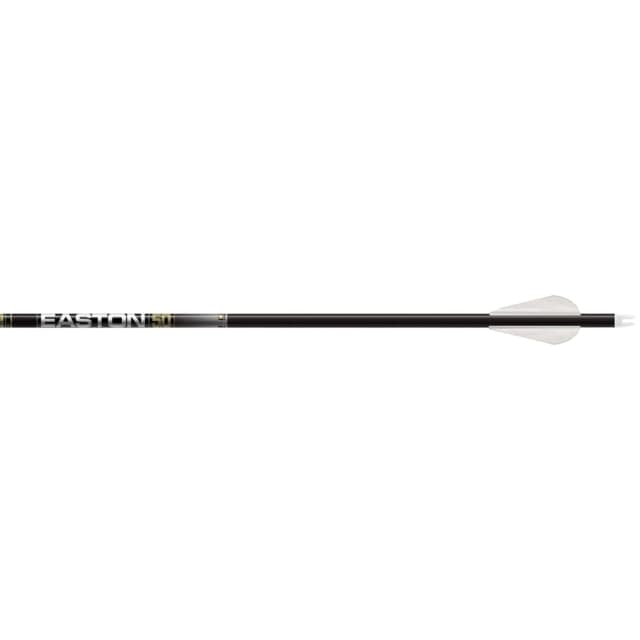
Easton 5.0
| Price | $110 per fletched 6-pack as listed by the named tests; Easton publishes no price |
|---|---|
| Construction | 5mm Acu-Carbon, made in USA (maker page, June 2026) |
| Straightness | +/- .003 in standard; Match Grade sold separately |
| Spines | 200, 250, 300, 340, 400, 500 |
| Weight (named test) | 7.4 GPI in 340 spine, per Outdoor Life |
| Components | Microlite 5mm nocks; HIT inserts or 50-grain steel half-outs |
The 5.0 is the only arrow named in both of our sources' award lists, and they praise it from opposite directions. Outdoor Life's hunting-arrow roundup, written by P.J. Reilly of Lancaster Archery Supply, made it best overall on consistency grounds and called the build range real, from light and fast to high-FOC. GearJunkie's 2026 roundup slotted it best lightweight for the flat trajectory that low grains-per-inch buys. Criterion 1 is the maker's argument too: Easton's single-process Acu-Carbon line is the consistency claim, and the 200-to-500 spine chart is the widest of our verified lines, which is criterion 3 covered for nearly any setup running a 100-grain head.
The owner feedback matches the adoption the awards imply: the 5.0 is a common upgrade target, credited for low grains-per-inch, flat flight, and easy FOC building, with owners reporting no breakage over long practice strings. Two honest qualifiers go with that. The lived durability evidence is lighter than the enthusiasm, and the one pointed negative is a single owner relaying secondhand forum reports of shafts failing when flexed, which we pass along as hearsay rather than a finding because no owner in the pull described breaking one himself. The component system also splits opinion: most owners get on fine with the HIT inserts and collars, while a few prefer Victory's insert system and say so.
Who it fits: the whitetail and mule deer hunter on a modern rig who wants one dozen that tunes easily and shoots flat. Who should not buy it: the elk and moose hunter building past 500 grains, who is the next pick's reader, and anyone who wants the .001 tolerance, which costs extra in Match Grade.
The drawback: It is built light, and light costs penetration. GearJunkie's roundup says it plainly, that lighter arrows may not penetrate as much, and Easton itself positions the 5.0 as its lightest hunting carbon. A heavy-game, heavy-bone build wants the next pick instead, and Easton publishing no price on its own spec page means you price this at the counter, not from the couch.
Heavy-build pick
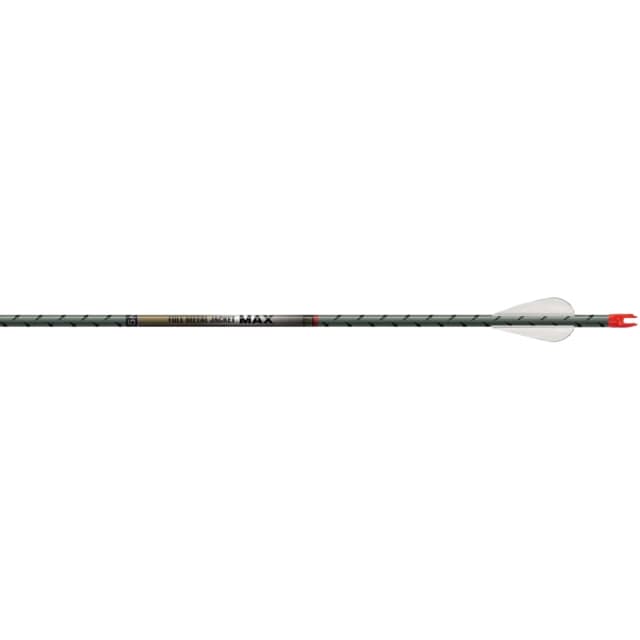
Easton 5mm FMJ Max
| Price | $113.99 per 6-pack standard, $139.99 Match Grade, per Easton's launch pages |
|---|---|
| Construction | Acu-Carbon core, 7075-alloy metal jacket, .280 in OD (maker page, June 2026) |
| Straightness | two grades; the maker's material describes .003 standard and .001 Match Grade |
| Spines and weight | 200 (13.3 GPI), 250 (11.3), 300 (10.3), 340 (9.8), 400 (9.0) |
| Components | Microlite 5mm nocks; HIT inserts or 50-grain steel half-outs |
This is the penetration end of the budget the match section priced. The maker-verified numbers carry the argument: a carbon core inside a 7075-alloy jacket, with the heaviest spine running 13.3 grains per inch, which builds a finished arrow well past the 500-grain line at hunting lengths. Outdoor Life made it best heavyweight, and that entry came with no stated criticism, so the weak-signal rule above applies and we say so. The criterion 2 case is the construction itself plus the maker's spec-table candor, the only line here publishing per-spine GPI on the product page.
On owner evidence this is the pick to read carefully, because the community pull captured the broad FMJ family more than the 5mm Max specifically. Only a handful of comments named the Max, and none of those isolated the 5mm diameter, so we treat the owner read as family-level and the Max-specific signal as thin. At the family level the picture is consistent: owners call the FMJ heavy and tough and a frequent pro-shop default for deer and elk, and the price is the standing complaint. Penetration is where owners disagree, one reporting a bison pass-through and another poor penetration into whitetail ribs on a light setup, which is the front-of-center argument the heavy-build reader should run for their own draw. One note on the drawback above: the metal-jacket cutting concern is ours from the construction, not an owner report, since nobody in the pull described bent jackets or trouble pulling the shafts, and the one pull-related comment was positive.
Who it fits: the elk, moose, and bear hunter, the low-poundage shooter buying momentum with mass, and the quiet-bow obsessive. Who should not buy it: the open-country deer hunter stretching ranges, who pays the trajectory tax on every yard of range error.
The drawback: Weight is the point and weight is the price. At 9 to 13.3 grains per inch the finished arrow gives up real trajectory, which means rangefinding errors cost more. The metal jacket also is a shop consideration: an aluminum-jacketed shaft is not a job for the basic home arrow saw, so plan on the pro shop for cuts. And our better-protocol source praised it without naming a single drawback, which our rules treat as corroboration of the maker's positioning, not independent proof.
Value pick
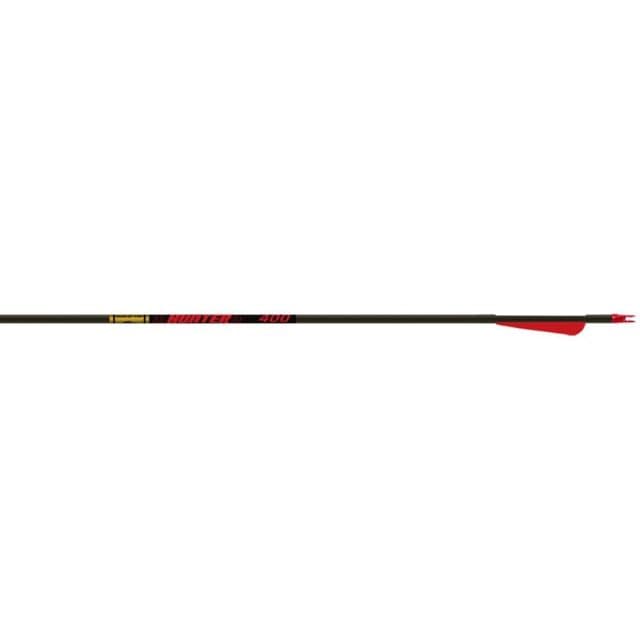
Gold Tip Hunter
| Price | $59.99 per 6-pack MSRP |
|---|---|
| Construction | 100 percent carbon, .246 in ID (maker page, June 2026) |
| Straightness | +/- .006 in |
| Weight tolerance | +/- 2 gr |
| Spines | 300, 340, 400, 500 |
| Components | nock and insert included; 2 in vanes or 4 in feathers |
Criterion 4 leads here and the maker's page makes it concrete: $59.99 for six with the nock and insert already in the box, which prices a finished half-dozen below the bare-shaft cost of much of the field. Note GearJunkie's listed $54 is stale against the maker's current page, the kind of drift that is why we verify at the source. Both the maker and GearJunkie's best-budget award make the same case, that the Hunter shoots with lines costing twice as much, and Gold Tip's carbon durability claim, unmatched straightness retention, is the criterion 2 argument: it keeps the straightness it ships with.
The owner feedback is the strongest in this guide and it backs the value pick from every direction the criteria care about. Owners call it the default first dozen and the durability benchmark cheaper shafts get measured against, and several walk through cutting an XT shaft down to tighten its straightness toward the premium grade, which is the tolerance line above turned into a workshop habit. Pass-throughs on deer are reported as routine, with the lone penetration complaint coming from a deliberately light build, the same speed-versus-mass budget the match section priced. For a value pick a clean owner record on durability is the whole point, and this one has it.
Who it fits: the new builder, the high-volume practice shooter, anyone fletching their first dozen who would rather spend the savings on a better head. Who should not buy it: the tolerance-first builder and the open-country hunter who wants micro-diameter wind behavior, both of whom are buying exactly what this line trades away.
The drawback: The tolerances are the price tag. A stated .006 in straightness is twice the standard-grade figure of the picks above, and the .246 standard diameter gives up the wind and penetration edge the micro-diameter field sells. Gold Tip's published straightness-retention claim is about staying at .006, which is honest and also not the same thing as starting tighter.
What to skip
Nothing in this field earns a skip. None of the named sources failed an arrow, and owner feedback surfaced only scattered one-off complaints, nothing that repeats. Two arrows are easy to buy for the wrong reasons, though. The Ultraview UV 1K is $220 for six and sold only as a complete closed system: a fine buy if you want that system, an expensive mistake if you just want arrows. And the Easton X10 Parallel Pro carries target-line pricing into the woods: built for shooters who want target-grade tolerances, not a general hunting upgrade. Know which buyer you are before paying for either.
The rest of the field
These lines earned attention without a pick, and none ships a spec table here because we could not verify them at the maker.
The Victory VAP TKO Elite is GearJunkie's best overall, at $180 with a .166 micro-diameter the testers credited for wind behavior and penetration, and one named flaw, stock inserts the testers did not rate. That is the disagreement with Outdoor Life's Easton 5.0 verdict, and we resolve it by criteria rather than averaging: on consistency claims and line range our criterion order lands on the 5.0, and the TKO Elite remains the micro-diameter alternative for the insert-upgrading builder. Owners back the durability hard, several still on their original dozen after rock and 3D-target hits, and that is the loudest theme in its pull; the recurring knock is provenance more than performance, owners noting the aluminum outserts and the outsourced carbon, with one flagging a too-tight stock nock that frayed the serving. Worth stating plainly: owners did not discuss the micro-diameter's wind behavior, so that part of the case stays the testers', not the field's. The Victory HLR Elite and RIP XV Elite took Outdoor Life's long-range and lightweight slots at $180 to $235, the latter at a field-lightest 6.4 GPI. The Black Eagle Talon V2 was Outdoor Life's value award at $70 a fletched 6-pack in .003 straightness, which undercuts our value pick's tolerance at a higher price; without maker verification it stays here, and it is the first line we would re-check when the next update lands. The Day Six HD is GearJunkie's elk pick and the Black Eagle Instinct its traditional pick, both attributed as positions we have not cross-checked. On the Day Six HD we can add an owner read, with the caveat that the line's name collides with an everyday phrase and the usable pull is about 18 arrow-specific comments: owners describe the shafts as close to bombproof, thick-walled enough to buy fewer and keep longer, and built for heavy elk arrows, the standing tradeoffs being a premium price and the trajectory drop any heavy build pays.
If you are starting from zero
Buy the match, then the dozen. Get your draw length and draw weight from your shop or our compound bow guide, pick the head weight you intend to hunt (our broadheads guide is the other half of this decision), and read the maker's spine chart for that combination. Order six before twelve: a half-dozen proves the tune and the vendor before you commit a season's budget. Have the shop cut and square the shafts, because a clean square end under the insert is cheap accuracy. And weigh the finished arrows; a dozen that matches on the scale is the consistency criterion made visible at home.
The criteria, the evidence basis, and the standing rule that we never claim testing we have not done are on the how we test page. Arrow coverage builds on the arrows hub, and the guides index has everything live today.
More guides
Publication note
June 15, 2026: owner reviews added to the picks and the rest-of-field notes. Gold Tip Hunter and the Victory VAP TKO carry strong owner feedback; the Easton FMJ pull reads at the family level and the 5mm Max specifically stays thin, which the pick flags. Initial publication June 12, 2026.