The best compound bows of 2026
Four criteria, weighted before we looked at a single bow, then applied to a verified field: a named four-tester shoot-off, manufacturer-checked specs, and owner reports at stated scale.
By Bowhunt America | Published 2026-06-12
Updated 2026-06-15

The verdicts, up front
- Top pick: Elite Varos
- Lightweight pick: Mathews Lift X
- Fit pick: Hoyt Alpha AX-3
- Budget: Not called yet; the honest reason is below
How we picked
Draw cycle and forgiveness came first. Build quality and reliability second. Fit range and adjustability third. Price against the field last, because you set the budget, the bow does not.
This guide is for the hunter replacing a rig that is five or more seasons old, and for the newer shooter buying a first serious bow. Four criteria drove it, set and weighted before we examined a single product page. The full basis for every claim is in the methodology block below, including the uneven owner data behind the flagship picks, which is substantial for one, thin for another, and not yet in for the third. Where the evidence is thin, this page says so instead of rounding up.
The criteria, in the order they were weighted
Set before any bow was examined, in this order, for these reasons: you live with the draw cycle on every practice session and every shot at an animal; a bow that fails mid-season is worse than one that draws stiff; a bow that does not fit is a miss before it starts, but fit is checkable before purchase; and price comes last because your budget is your call.
- Draw cycle and forgiveness: how the bow draws, holds, and behaves on a slow, cold pull
- Build quality and reliability: cams, limbs, finish, and warranty patterns over seasons
- Fit range and adjustability: draw-length and draw-weight ranges, and what changing them takes
- Price and value against the field: the verified price, judged against what the first three deliver
How we reviewed this
- Criteria:
- The four criteria above, in weighted order, committed before product research began.
- Evidence:
- Verified manufacturer specs, pulled from each maker's current page and dated June 12, 2026 (Mathews, Elite, and Hoyt verified; where a maker's page could not be reached, no spec table appears for that bow). Two named expert sources, compared against each other: Outdoor Life's 2026 seven-bow shoot-off (four named testers, 405 arrows over three days, nine averaged 50-yard groups per bow, chronographed at standardized settings) and Bowhunter.com's Mathews Lift X review (favorable throughout with no stated criticism, which we treat as a weak single-source signal and say so). Owner reviews read at scale, added June 15, 2026: community discussion pulled from Reddit's bowhunting and archery boards, chiefly [r/bowhunting](https://www.reddit.com/r/bowhunting/) and [r/Archery](https://www.reddit.com/r/Archery/), and counted by how many comments actually speak to owning the bow rather than name-dropping it. Owner feedback on the Diamond Edge 320 remains the strongest, about 46 on-topic comments across 46 threads, and it drove the budget section below. Owner feedback on the Mathews Lift X is substantial, roughly 35 substantive comments from many separate owners, and it is read into that pick. Owner feedback on the Elite Varos came back thin: of 52 raw hits most were an unrelated game character and place name, leaving about seven owner comments with six of those from a single poster, so we read its owner signal as one enthusiast's voice and say so rather than dress it up. No owner feedback was pulled for the Hoyt Alpha AX-3 this pass, so its reliability read still rests on the shoot-off's build observations alone. Where owner evidence is thin or absent, the pick says so.
- Updated:
- June 15, 2026: owner feedback added for the flagship picks (Lift X substantial, Varos thin, Hoyt not pulled this pass). June 12, 2026: initial publication.
The spec-sheet numbers we ignored, and why
Three numbers dominate bow marketing and tell you less than they imply.
IBO and ATA speed ratings. These are measured at settings most hunters do not shoot: maximum draw length, heavy draw weight, a light arrow. Mathews lists the Lift X at "up to 348 fps," and that phrasing is doing honest work that the big print undoes: your setup will be slower, and the difference between two bows rated 10 fps apart will usually vanish entirely at your draw length and arrow weight. We report measured speeds from Outdoor Life's 2026 seven-bow shoot-off where they exist, at the test's stated settings, and treat catalog speed as marketing.
Brace height as a forgiveness score. Brace height is the distance from the grip to the string at rest. The folk rule says longer is more forgiving. There is something to it, and the test data below includes a bow that shows why it is not the whole story. It is one input among several, not a verdict.
Let-off percentages. Let-off is how much of the peak draw weight the cams hold for you at full draw. The differences between 80, 85, and 90 percent read large on paper and small at full draw on a cold morning. Valley behavior, which no spec sheet reports, matters more, and it shows up twice in the findings below.
The picks
Top pick
Elite Varos
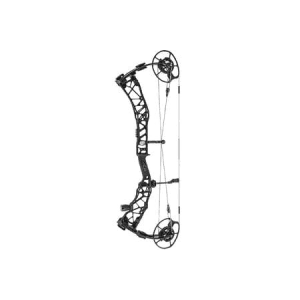
| Price | $1,299.99 MSRP |
|---|---|
| Axle-to-axle | 32 in (maker page, June 2026) |
| Brace height | 6.625 in |
| Bare weight | 4.75 lb |
| Draw weights | 40, 50, 60, 65, 70, 75 lb |
| Draw lengths | 25.5 to 31 in, quarter-inch steps via VX mods |
| Let-off | up to 90 percent |
| Measured speed (Outdoor Life shoot-off) | 285.8 fps at 60 lb, 29.5 in, 389 gr |
The Varos took the top verdict in Outdoor Life's 2026 seven-bow shoot-off, and the language matters: the testers called it the easiest bow to be accurate with and the most accurate bow they tested, across nine averaged 50-yard groups per bow. That is criterion 1 evidence of the most direct kind available without our own range time. Fit range is wide for a flagship (six draw weights down to 40 lb, a 5.5 in draw-length spread adjustable by mods rather than a bow press, and a left-hand option). And at a verified $1,299.99 it is the cheapest bow in the test field, which settles criterion 4: nothing above it delivers more per dollar on the evidence we have.
Who it fits: the accuracy-first hunter, the upgrader who wants flagship performance without the $1,500 tier. Who should not buy it: shooters who camp at full draw waiting on a hog or a strutting tom; that valley dump is real, and it is in the drawback for a reason.
Owner reports are thin enough that we will flag them as thin. The Only about seven Varos owners turned up, and six of those are one shooter's posts across several threads, who credits a jump in arrow speed and a steadier hold at full draw after moving up from a mid-tier Elite. One shooter who only test-drew it noted having to concentrate to keep the short bow level left to right, and blamed either the short axle-to-axle or himself. That reads as corroboration of the shoot-off's accuracy verdict, not as an independent owner consensus, and we are not going to turn seven comments into one. Worth noting for the drawback above: no owner we read raised the valley either way, so that criticism stands as the test's, not the field's.
The drawback: The valley. The shoot-off's one sharp criticism was a severe dump into the valley, meaning the bow wants to jump forward if you relax at full draw, enough to move the sight picture. Owners of smooth-valley bows will feel it immediately, and a long-hold whitetail hunter should shoot it before buying.
See price at Sportsman's Outdoor Superstore ($1,299.99 MSRP)
Lightweight pick
Mathews Lift X (29.5)
| Price | $1,359 MSRP |
|---|---|
| Axle-to-axle | 29.5 in (maker page, June 2026) |
| Brace height | 6 in |
| Bare weight | 3.99 lb |
| Draw weights | 55 to 80 lb |
| Draw lengths | 24.5 to 30 in |
| Let-off | 80 or 85 percent |
| Catalog speed | listed as up to 348 fps; treat as marketing, see above |
At a verified 3.99 lb bare and 29.5 in axle-to-axle, this is the pick for the hunter who carries the bow farther than they shoot it: saddle and treestand hunters, public-land walkers, elk country. Bowhunter.com's Lift X review, the one current expert review we have, praises exactly that profile, quiet and compact with almost imperceptible vibration at the shot. Honesty requires the caveat: that review states no criticism at all, and a review with no drawback is a weak signal on its own, so we are treating it as corroboration of the maker's positioning rather than independent proof. The spec table is maker-verified.
Owner feedback is now in, and it both backs the review and complicates it. Owners consistently call the bow quiet and dead in the hand, and the press-free limb-shift tuning is the feature they single out as the reason to buy; the light carry weight earns the same credit the review gives it. The complication is the draw cycle. A recurring owner line is that it draws rough and torques easily, with a short valley, and the fix owners reach for is a set of aftermarket draw-comfort mods, which is a cost and a caveat the maker's page does not mention. On reliability, the limb-delamination reputation that trails the word "Lift" online belongs to the original 2024 Lift; owners put the redesigned Lift X failure rate at the normal range for a flagship, which is the reassurance a spec sheet cannot give. And the draw-weight reports track the floor in the drawback: owners say it pulls smoothest at 55 pounds and gets jerky toward 70 as fatigue sets in, with one cautionary post from a shooter who over-bowed himself at 70 and hurt a shoulder.
Who it fits: the weight-conscious hunter with an established draw weight of 55 lb or more. Who should not buy it: anyone under that floor, and anyone who wants third-party test data before spending $1,359, because for this bow it is thinner than we would like.
The drawback: The 55 lb floor. The draw-weight range starts where many shooters, smaller-framed adults, and anyone rebuilding form after a shoulder injury need it to end. If you need to train up from 45 or 50 lb, this bow has no setting for you, and that is a hard exclusion, not a quibble.
Fit pick
Hoyt Alpha AX-3
| Price | $1,499 MSRP |
|---|---|
| Draw weights | 40 to 80 lb (maker family page, June 2026) |
| Draw lengths (29 config) | 25 to 30 in, quarter-inch adjustable |
| Axle-to-axle (29 config) | 29.5 in |
| Brace height (29 config) | 6.375 in |
| Measured, 33 config (Outdoor Life shoot-off) | 33.56 in ATA, 4.75 lb, 285.6 fps |
The shoot-off called this grip the team's favorite of the year, and grip is the contact point your accuracy runs through. The criterion this bow actually wins, though, is fit: a verified 40-to-80 lb draw-weight range is the widest of any flagship here, quarter-inch draw-length adjustment, and the family ships in four configurations including short-draw and long-draw. If the Varos and the Lift X both miss your dimensions, this one almost certainly will not.
One honesty note on evidence: no owner feedback has come in for the AX-3 yet, so the fit and grip case here rests on the shoot-off alone, and reliability at scale stays the open item for this pick. When it does, the update line at the top will say what it found.
Who it fits: shooters at the edges of the fit charts, and hunters who want the test team's favorite grip. Who should not buy it: the value-driven buyer; on the evidence, it is a half step behind the top pick at $200 more.
The drawback: Price and a paper gap. It is the most expensive pick here at $1,499, and Hoyt's own page for the 33 configuration was unreachable when we verified specs, so the 33's numbers in this table come from the Outdoor Life shoot-off rather than the maker. We publish that gap instead of papering over it; check the 33's page before ordering one.
The budget pick we are not ready to call
The Diamond Edge 320 is the bow the owner data points at: across 50 owner comments in 46 separate discussion threads, it is the most recommended first and budget bow we found, with adjustability the recurring reason (11 of 50 comments) and price the constant frame (22 of 50). Owners repeatedly cite a 7-to-70 lb adjustment range; at least one owner reports the 7 lb floor is not practically reachable, and we found one documented mechanical failure, a sheared cam retainer pin replaced under warranty.
Here is why it is a section and not a pick: we could not verify a single spec at the manufacturer's page, which was unreachable by every route we tried, and our standard is that an unverified spec table does not ship. The owner evidence is real and we are showing it; the verification is missing and we are saying it. When the maker's specs are verified, this section becomes a full pick with a table, and the update line at the top of this page will say so. That is how every upgrade on this site works.
What to skip
PSE Sicario, for the hunting reader. Skip it for hunting: accuracy-supporting qualities outrank speed in the criteria here, and this bow trades one for the other. The shoot-off measured it fastest in the field by 20 fps but also reported it struggled with accuracy, the testers pointing at its short 5.25 in brace height, the honest nuance to the brace-height myth above. At a stated $1,999 it is also the most expensive bow in the test. Who actually wants it: the experienced, target-adjacent shooter who prizes a flat trajectory and puts in the practice volume to manage an unforgiving setup.
The rest of the field
The shoot-off covered three more bows we could not maker-verify, so they appear here with test attribution only. The Mathews ARC 34 was the testers' unanimous best draw cycle, drawing like a far lighter bow, with a short valley needing constant pressure on the stops as its stated criticism; if smoothness is your first criterion, it deserves a shop visit, and we will table it when its specs verify. The Bowtech Alliance 30 drew second-best with a wall the testers called too soft and a grip too thin and deep. The Darton Tritech 33 earned smooth-draw and comfortable-grip praise at $1,350, with a cumbersome multi-screw draw-length change as its stated flaw. The Xpedition NexLite 33 was the test's lightest at a stated 3.75 lb with some bare-bow jump noted.
If you are starting from zero
Three terms unlock the spec tables above. Draw length is the distance you pull the string at full draw, measured in inches; a shop measures yours in five minutes, and it matters more than any other number here. The draw length calculator gets you a working estimate before you go. Draw weight is the peak pounds you pull through the draw cycle; start lower than your ego suggests and build. Let-off is the percentage of that peak the cams hold for you while you aim. Buy the bow that fits those three numbers today, with enough adjustment range to follow you as your form improves; that logic is why the budget section above leans adjustable, and why fit is a top-three criterion on this page rather than a footnote.
The criteria, the evidence basis, and the standing rule that we never claim testing we have not done are all on the how we test page. More bow coverage lands on the bows hub as the season builds, and the guides index has everything live today.
More guides
Publication note
June 15, 2026: owner-feedback pulls added for the flagship picks. The Mathews Lift X gains substantial owner feedback; the Elite Varos owner signal came back thin and is flagged as such; the Hoyt Alpha AX-3 still has no owner feedback yet. Initial publication June 12, 2026.